
I became obsessed with a problem not because it was intellectually interesting, but because it was personal.
I’ve watched people send money across countries and lose 8% to fees. I’ve seen a market trader in Abuja turn away a tourist because the POS was offline again. I’ve seen someone hold USDC and still be unable to send it, stuck on something as simple as gas fees.
And then there was that moment in Lagos IshowSpeed asked a vendor if they accept USDC or USDT, and the answer was yes.
That’s when it clicked: the problem isn’t infrastructure. It’s usability.
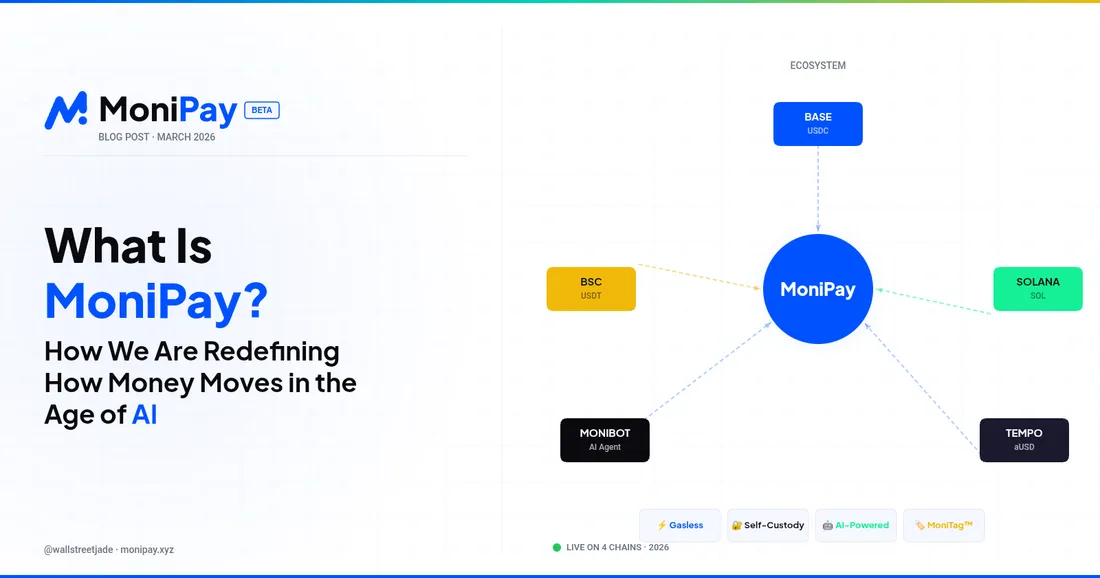
The infrastructure for a better financial system has existed for years. The missing piece was always the experience. That is what we are building with Monipay.
The Problem Is Not Blockchain. It Is UX.
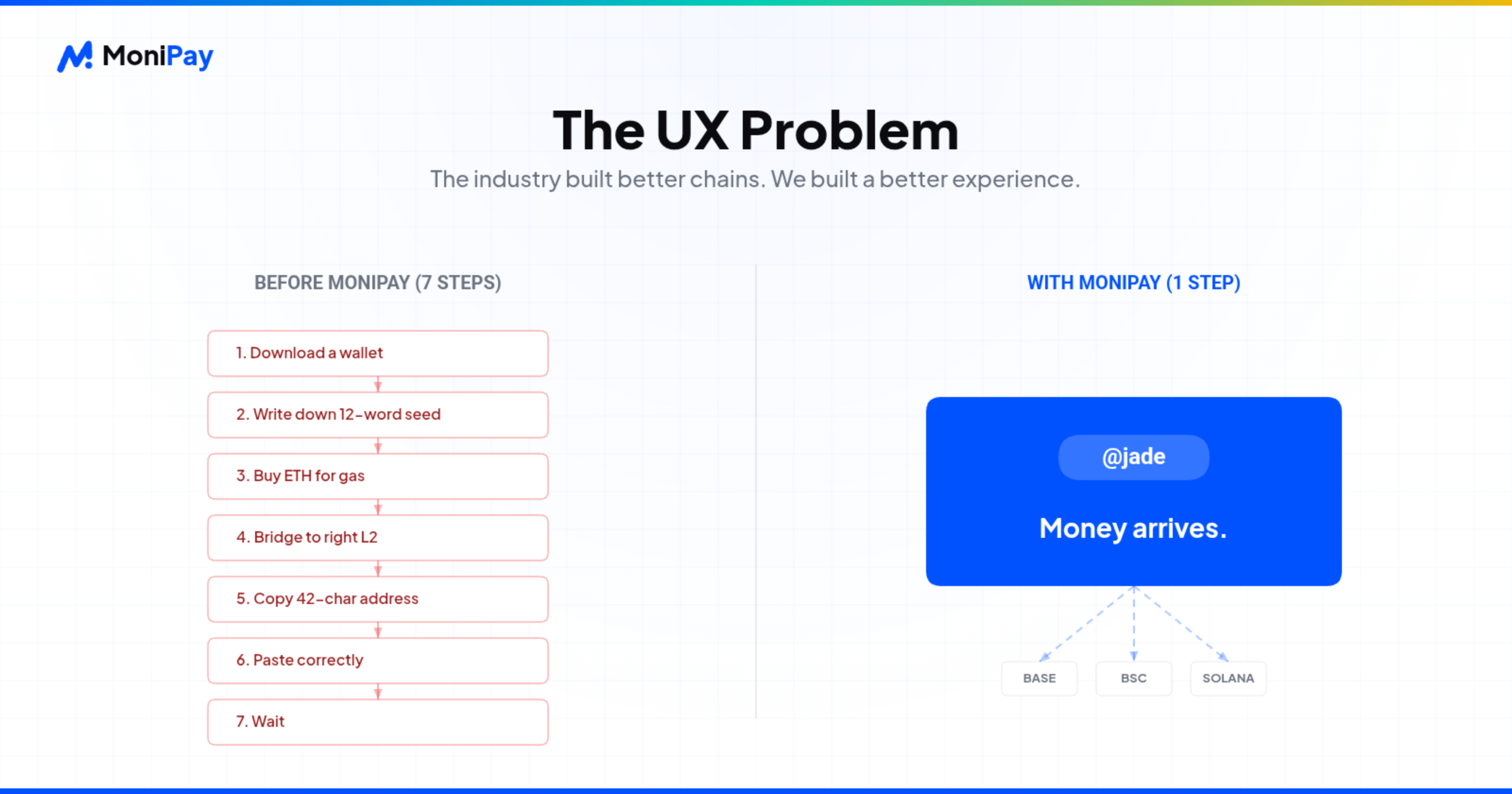
Here is what sending stablecoins looked like before Monipay:
-
Download a wallet
-
Write down a 12-word seed phrase
-
Buy ETH just to pay gas on USDC transfers
-
Bridge to the right L2
-
Copy a 42-character wallet address
-
Paste it correctly
-
Confirm the transaction
-
Wait
That is seven steps to send five dollars. Western Union requires fewer steps. That is the UX crisis crypto has been living with and calling progress.
The industry spent years building faster chains, cheaper gas, and more powerful smart contracts. All of that work was necessary. But none of it solved the real problem: normal people cannot use this.
The average person who would benefit most from stablecoins, the person in Lagos or Nairobi or Manila who is losing 10% of their salary to remittance fees, cannot navigate that seven-step flow. They close the app and never come back.
What We Built
Monipay is a non-custodial, AI-powered smart payment platform that collapses those seven steps into one.
You pick a moniTag™. A simple username. Something like @jade. That username becomes your universal payment address across every chain we support. No wallet addresses. No chain selection. No gas management.
Someone wants to pay you. They type @jade. Money arrives.
That is the entire user experience.
The Three Pillars
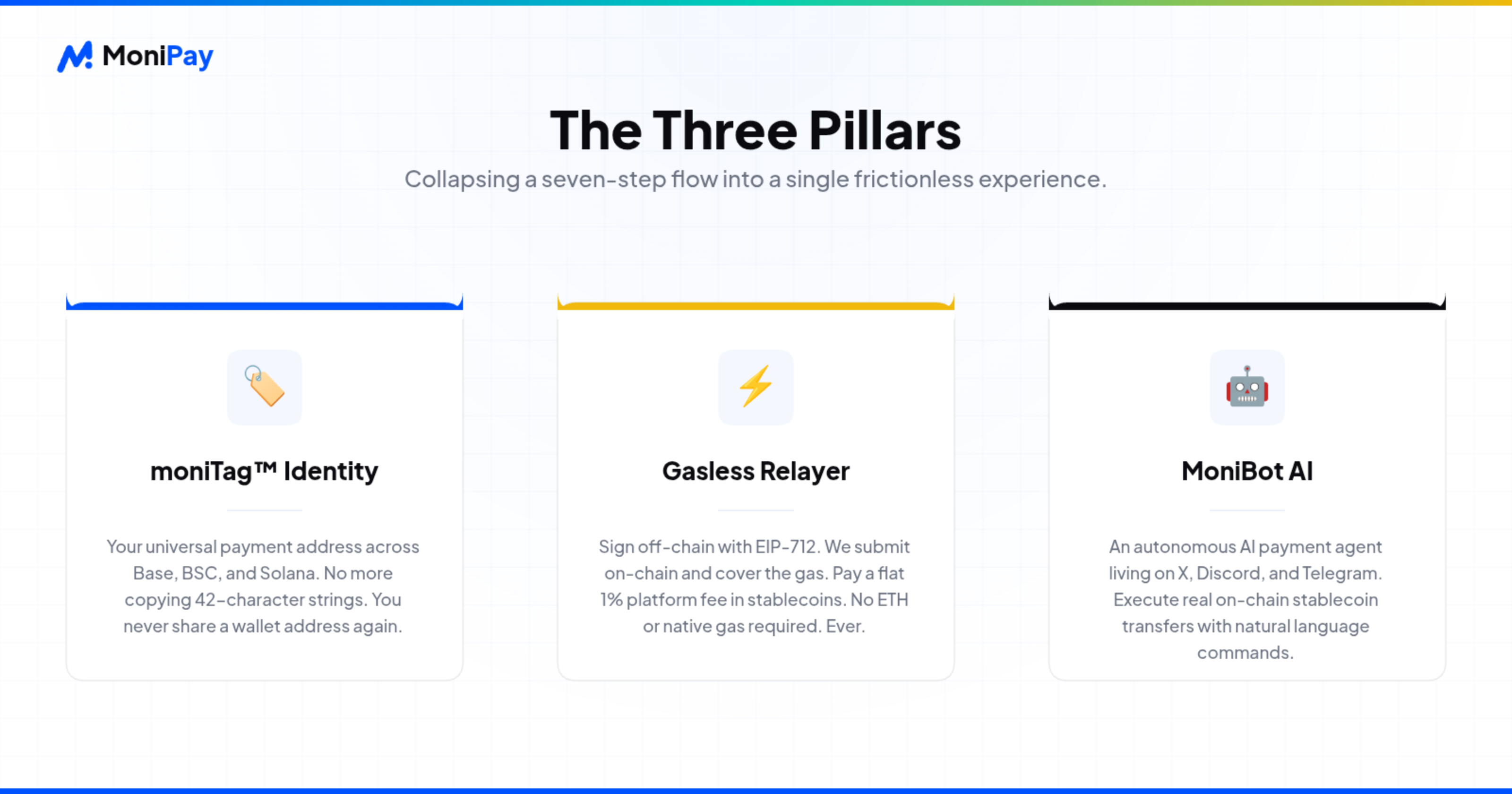 moniTag™ Identity
Your moniTag™ is your payment identity across Base, BSC, and Solana simultaneously. We resolve it to the correct wallet address on whatever chain the sender is using. You never have to tell anyone which chain you are on. You never share a wallet address again.
Gasless Relayer
We built an intelligent custom EIP-712 gasless relayer infrastructure. When you send a payment on Monipay, you sign a typed message off-chain. Our relayer submits the transaction on-chain and covers the gas. You pay a flat 1% platform fee. That is it. No ETH required. Ever.
This is where things get genuinely new. MoniBot is an autonomous AI payment agent that lives on Twitter/X, Discord, and Telegram. You mention it with a natural language command and it executes a real on-chain USDC, aUSD or USDT transfer automatically.
@monibot send $5 to @alice
@monibot send $2 each to @bob, @charlie, @dave
@monibot send $1 to first 50 replies
One tweet. Payments distributed to unlimited recipients. Settled on Base or BSC in seconds. No spreadsheet. No manual DMs. No wallet address collection.
The Problems We Ran Into
I want to be honest about the journey because I think the crypto space benefits from founders being specific about what was hard and why.
Account Abstraction Was Not the Answer
When I started thinking about how to eliminate gas fees from the user experience, the natural place to look was Account Abstraction and ERC-4337. The Ethereum community has been working on this problem since 2016. ERC-4337 launched on mainnet in March 2023. Over 40 million smart accounts have been deployed across Ethereum and Layer 2 networks, with nearly 20 million deployed in 2024 alone.
It’s is impressive infrastructure. But it was not the right fit for what we were building.
UserOps remain around 2% of Base’s volume. Challenges include gas inefficiency, app incompatibility, multi-chain state sync issues, and fragile infrastructure. UserOps are more expensive than native transactions, especially on Ethereum mainnet.
More practically: users with existing EOA accounts cannot simply convert to ERC-4337 smart wallets without creating new addresses and transferring all assets. We were building for people who might be new to crypto entirely. Asking them to understand the difference between an EOA and a smart contract wallet before they can send their first payment was a non-starter.
ERC-4337 is building toward something real. EIP-7702, introduced with the Pectra upgrade in May 2025, makes things meaningfully better by allowing EOAs to execute smart contract code without migrating assets. But it still concentrates significant security risk in the EntryPoint contract that sits at the center of every transaction.
We decided to take a different path. Our EIP-712 relayer approach achieves the same gasless outcome through a simpler mechanism: users sign typed messages off-chain, our relayer submits on-chain. No alternative mempool. No bundlers. No EntryPoint. The user experience is identical but the architecture is leaner and the security model is more transparent.
Chain Abstraction Is Still a Vision
Multi-chain payments sound simple until you actually build them. Every chain has its own RPC format, its own token standards, its own transaction model. Base uses USDC with 6 decimals on EVM. BSC uses USDT with 18 decimals on EVM. Solana uses a completely different account model with Ed25519 keypairs and SPL tokens instead of ERC-20.
The dream of true chain abstraction, where users never think about which chain they are on, runs into the reality that the underlying infrastructure is fundamentally different across these ecosystems. Bridging assets cross-chain introduces counterparty risk. Cross-chain messaging adds latency and cost.
Our solution was to embrace multi-chain rather than abstract it away. We run separate optimised payment flows for each chain. Users pick their preferred network once in settings. moniTag™ resolves to the correct address for that network. The user sees a consistent experience. Under the hood, it is three different payment systems that we maintain and improve independently.
It is more work. But it is honest engineering.
That said, We built something that gets meaningfully closer to that vision.
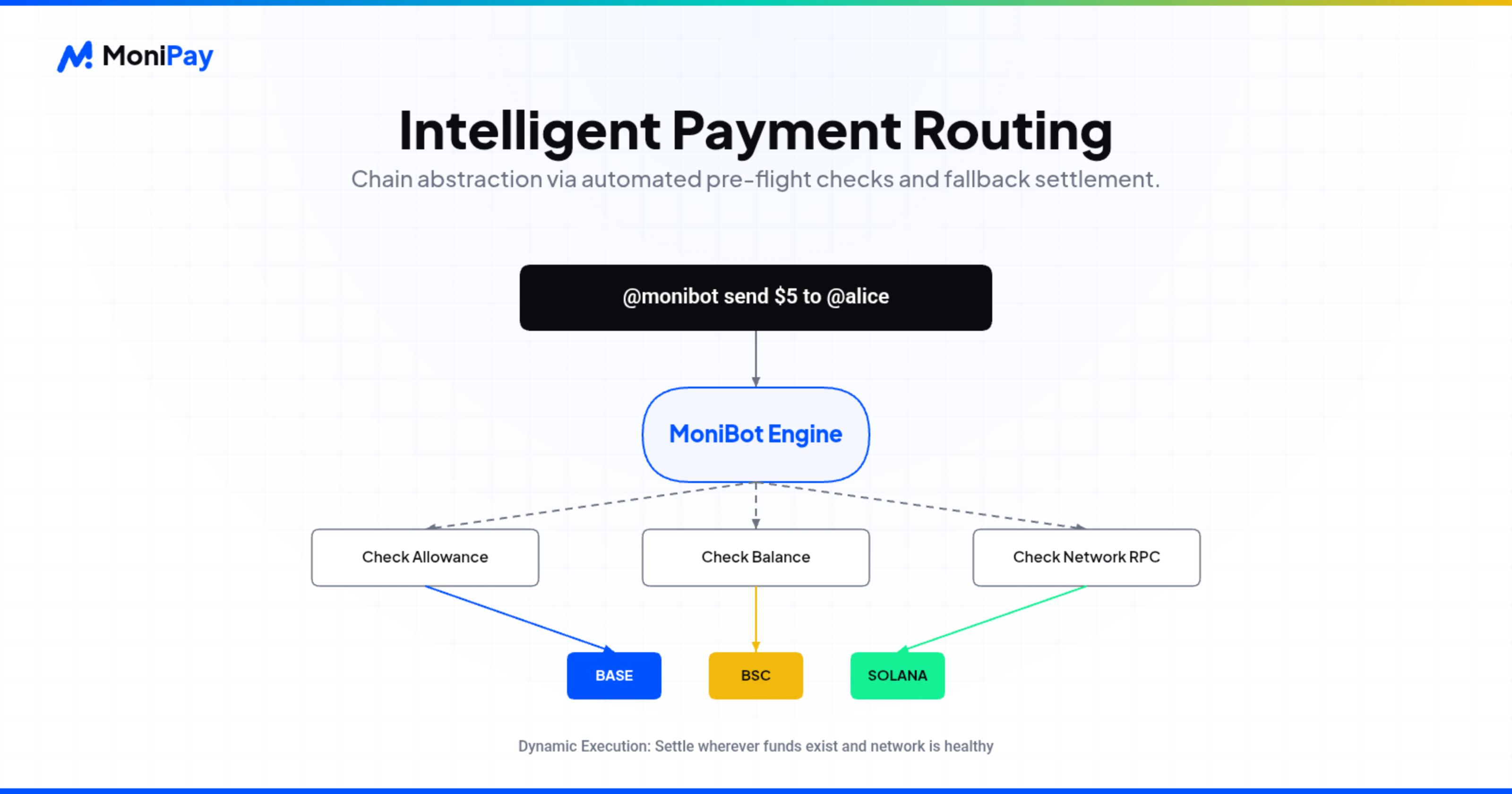 MoniBot routes payments intelligently at execution. It does not just follow the user’s selected chain and fail. Before any transaction, it checks three things.
If allowance is insufficient, it looks across other supported chains and routes the payment where approval already exists, then informs the user.
If balance is insufficient, it checks across chains and settles from wherever funds are available. The recipient gets paid and the sender sees where it settled.
If the network fails, it cycles through backup RPC endpoints. If the chain is still unreliable, it reroutes to a healthy one.
This is not full abstraction yet. The user still has a preferred chain. But the common failure points are removed.
You type a command. The payment goes through. Where it settles becomes a detail, not a decision.
That is the direction. The chain should be invisible to the user.
Tempo Raised the Bar and the Question
In September 2025, Stripe and Paradigm announced Tempo, a payments focused Layer 1 blockchain purpose built for stablecoin payments at internet scale. On March 18, 2026, Tempo Mainnet went live alongside the Machine Payments Protocol, an open standard for machine payments co-authored by Stripe and Tempo.
I want to be direct about this because it matters for understanding where we fit.
Tempo raised $500 million at a $5 billion valuation in 2025 from Thrive Capital, Greenoaks, Sequoia Capital, and Ribbit Capital. Their partners include Anthropic, OpenAI, Mastercard, Visa, Shopify, and Standard Chartered. That is extraordinary validation of the thesis that stablecoin payments infrastructure is one of the most important problems to solve right now.
But here is the thing the crypto-native community noticed immediately: the crypto and web3 research community raised questions about the trade-offs of corporate-backed chains like Tempo, particularly around decentralization and permissioning.
Tempo is currently a permissioned chain. The nodes that validate transactions are controlled by Tempo and its institutional partners. For enterprises that need regulatory certainty, that is a feature. For users who care about trustlessness and censorship resistance, it is a real trade-off.
This is where our philosophy diverges sharply.
Our Philosophy: Non-Custodial Is Not Negotiable
Monipay is built on a single non-negotiable principle: we never touch your money.
Your private key is generated on your device. It is encrypted with AES-GCM using PBKDF2 key derivation from your PIN. It is stored in hardware-backed secure storage. We have no copy. There is no backdoor. If we get hacked, the attacker gets nothing that can touch your funds.
This is not a marketing claim. It is the architecture.
The reason this matters so much right now is that the payment apps currently winning in crypto are mostly custodial. They hold your funds. They control your keys. They can freeze your account. They can go bankrupt. We watched FTX hold billions in customer funds and then not hold them anymore. We watched Celsius do the same thing.
The whole point of building on blockchains is that you should not have to trust a company with your money. We built Monipay so that you never have to trust us with yours.
What Monipay Does Right Now
Here is where things actually stand as of March 2026.
Personal payments are live. Send USDC to any moniTag™ on Base. Send USDT to any moniTag™ on BSC. Scan a QR code to pay a merchant. Receive payments via your branded moniTag™ QR & Username. Full transaction history with real-time sync.
Merchant suite is live. This is the part I am most proud of because nothing else in crypto comes close to what we built for merchants. Zero hardware required. Your phone is your payment terminal.
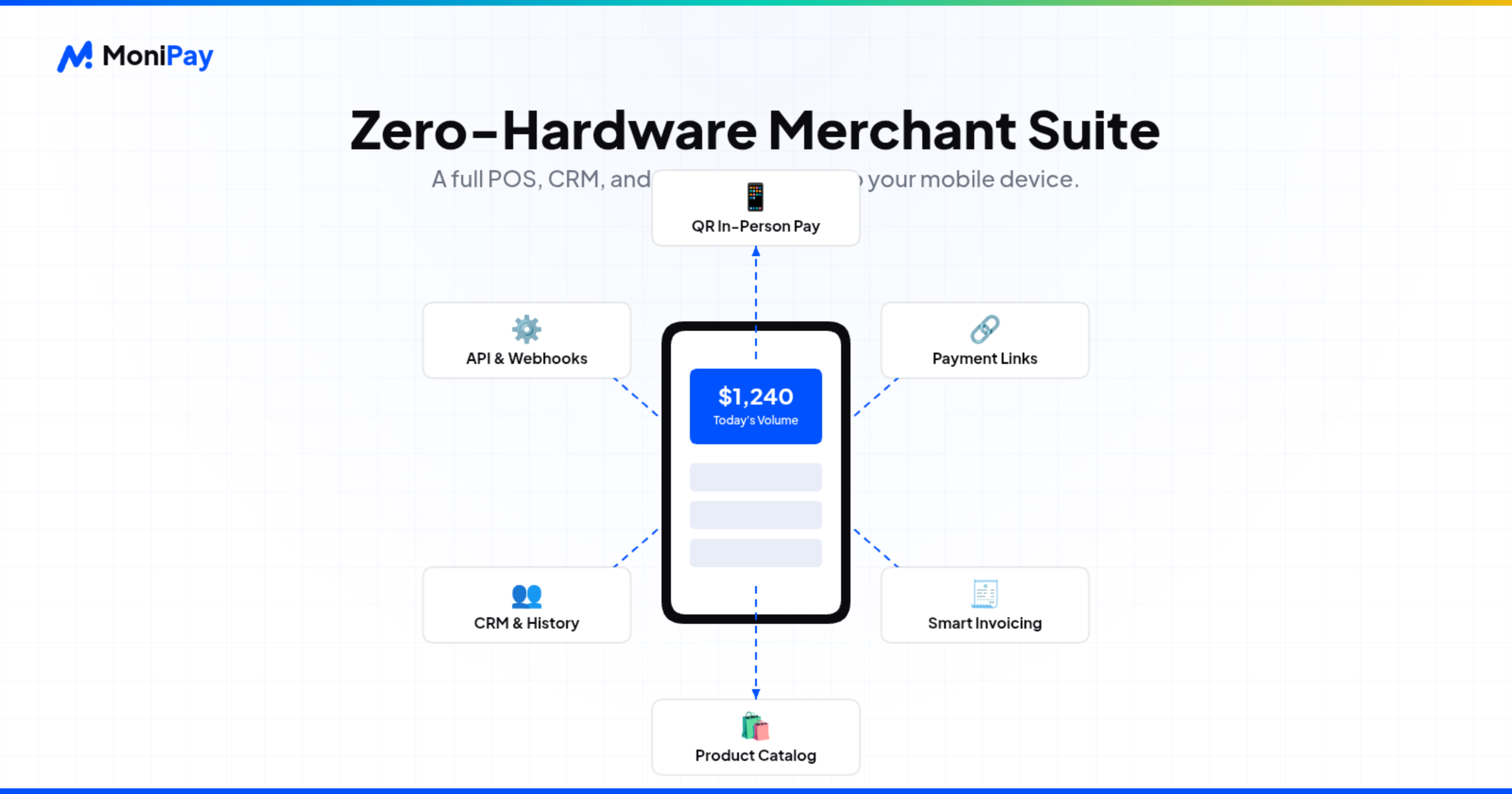 You get:
-
QR charge flow for in-person payments
-
Payment links that work anywhere, WhatsApp included
-
Invoicing with automatic payment detection
-
A full product catalog and online store
-
Webhooks for backend integration
-
A complete CRM with customer payment history
-
Real-time analytics
A market trader who cannot afford a POS terminal can download Monipay, create a moniTag™ in three minutes, and start accepting digital payments today. That is the product I wanted to exist when I started building.
MoniBot AI is live on Twitter/X, Discord, and Telegram. It processes real on-chain payments right now. We were publicly building this before any funded competitor entered the space.
Solana integration is 80% complete. Ed25519 keypair management via tweetnacl is integrated. SPL token support is in place. Full launch imminent.
The Market We Are Building For
Stablecoins processed $33 trillion in volume in 2025. That is 20x PayPal and approaching 3x Visa. The infrastructure won. The UX has not caught up yet.
Nigeria, where I am building from, is top 5 globally for peer-to-peer crypto volume. Sub-Saharan Africa saw stablecoin activity rise 52% year-over-year. People here are not speculating. They are using stablecoins because the alternative is a currency that lost 40% of its value in a year.
This is the market where the UX problem is most expensive. A 42-character wallet address is annoying when you are a developer in San Francisco. It is a barrier to financial inclusion when you are a small trader in Lagos.
We are building for the second person. The infrastructure exists. The experience is what has been missing.
What Comes Next
The immediate roadmap is Solana completion, then the MNS (MoniTag Name Service), our own multi-chain naming protocol that brings moniTag™ identity fully on-chain across Base, BSC, and Solana simultaneously. We are also building MAP, the MoniPay Agentic Payments standard, which addresses the gap that x402 and MPP both leave open: human-commanded agentic payments on social platforms.
Longer term, we are building NGN Monipay, a separate fiat Nigerian app that brings the same conversational payment experience to everyday naira transactions via regulated infrastructure. That is a different product with a different compliance stack. But the identity layer, the moniTagâ„¢, bridges both worlds.
Try It
The best explanation of Monipay is using it.
Create your moniTag™ at monipay.xyz. Read how it works. Look at the use cases. Try MoniBot AI.
We are early. The product will keep improving. But the thesis is correct and the infrastructure is real.
Payments should feel like sending a text message. We are building until they do.
Samuel ChiedozieFounder, Monipay@jadeofwallstreet
Monipay is live on Base and BSC. Solana & Tempo Mainnet coming soon. Read the docs. View the deck.
Tags: stablecoin payments, crypto UX, gasless transactions, MoniBot AI, agentic commerce, moniTag, Base, BSC, Solana, non-custodial wallet, social payments, conversational commerce, Web3 Nigeria, Africa crypto, EIP-712, account abstraction
Meta description: Monipay replaces wallet addresses with moniTag™, eliminates gas fees, and introduces MoniBot AI for conversational on-chain payments. Here is the full story of what we are building and why.

Discussion
Loading comments...