
Goodbye Long Addresses: Web3 Username Payments Explained
If you have ever sent cryptocurrency, you know the feeling. You copy a 42 character string of letters and numbers. You paste it. You check the first four characters. You check the last four characters. You hold your breath, click send, and wait for confirmation.
This anxiety is exactly why mainstream adoption of crypto has stalled. People do not want to interact with blockchain infrastructure directly. They want to send value as easily as they send a text message.
This is where username-based crypto wallets come in.
The Problem with Hex Addresses
Traditional blockchain wallets use hexadecimal addresses. They are brilliant for cryptography but terrible for humans. If you make a single typo, your money is gone.
When a user wants a free usdt transfer to pay a vendor, the current flow is broken. They have to open a wallet app, ask the vendor for a long address, ensure they are on the correct network, and pay gas fees in a native token they might not even own.
This is not a financial system for everyone. It is a system for technical users.
How Web3 Username Payments Work
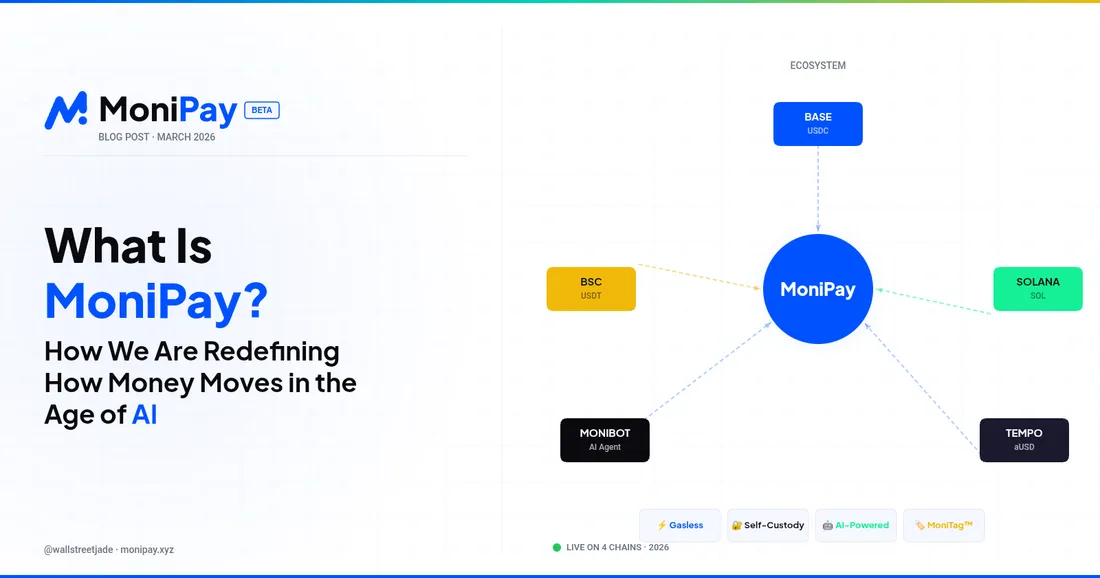
We built Monipay to fix this exact problem. Instead of wallet addresses, users claim a moniTag. A moniTag is a simple username, like @jade.
When you want to send crypto by username, you just type their moniTag. The protocol handles the rest. It automatically resolves the username to the correct wallet address across supported chains. You never see the long string.
This makes a crypto username wallet identical to using a traditional fiat app, but with the borderless power of stablecoins. It also enables a true gasless crypto transfer experience, because the protocol sponsors the network fees.
Social Payments and Conversations
Money is inherently Social. Most financial intents begin in conversations. You are splitting a bill in a Telegram group, tipping a creator on X, or rewarding a community member in Discord.
Forcing users to leave their social platforms, open a separate app, and paste an address breaks the natural flow of human interaction.
Through our autonomous AI agent, we bring execution directly into your social feeds. By leveraging Natural language processing, the AI understands exactly what you want to do.
You just type a command in your conversation: “@monibot send $5 to @alice”
The AI parses the intent, validates the balances, and executes the transfer. No extra app required. No switching screens.
What is a Non-Custodial Wallet?
A common concern with simple payment apps is custody. If an app is easy to use, people assume a centralized company holds the money.
So, what is a non-custodial wallet? It means you hold the private keys to your money. If the company goes offline, your funds are still safe on the blockchain.
Maintaining self-custody crypto is important, but it should not require technical expertise to keep control of your money. Monipay achieves this through local key generation. When you create an account, a private key is generated on your device and encrypted with a PIN. We never see your key. You get the simplicity of usernames without sacrificing the security of a non-custodial wallet architecture.
Try It Yourself
We are actively expanding these features through our native MiniPay integration. You can claim your username today and start experiencing what invisible blockchain payments look like.

Discussion
Loading comments...