
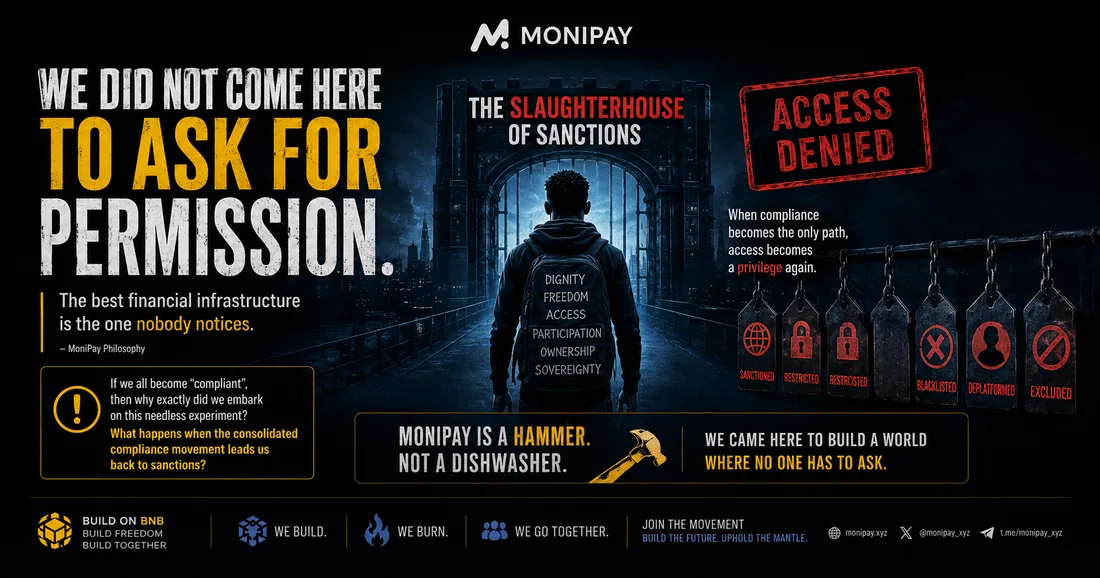
We Did Not Come Here to Ask for Permission
Why crypto mattered, why compliance drift matters, and why access must remain permissionless
I ask myself this question more often these days. If we all become “compliant,” then why exactly did we begin this experiment?
-
Why did we spend years building alternatives to the traditional financial system, only to slowly recreate the same gates, the same exclusions, and the same permission structures we were trying to escape?
-
What happens when the great compliance movement leads us right back to sanctions?
-
Back to a world where a small group of institutions decides who gets to participate in the global economy and who does not
I remember exactly why I entered this space. It was not ideology at first. It was necessity.
I was a freelancer. A small internet business operator. I sold a domain to someone in the United States, and like many young Africans trying to participate in the global digital economy, I ran into the same wall
There was no simple way to get paid. No easy cross border rails. No trusted infrastructure. No PayPal that actually worked for me.
The internet allowed me to create value globally, but the financial system refused to recognize that value locally.
Then came a platform called Epik. They had Bitcoin integrated directly into their escrow system. For the first time, I was able to receive payment in minutes without begging a bank, without waiting for approvals, without someone deciding whether I was eligible to be paid for my own work. I converted it into naira using Luno, and just like that, my first interaction with crypto happened almost by accident.
But something changed For the first time, money moved like the internet itself. Open. Borderless. Fast It did not care where I was born It did not ask for permission It simply worked That moment stayed with me. And for many people across Nigeria, Africa, and the broader Global South, that was the real introduction to crypto Not trading. Not speculation. Not charts.
- Dignity
- Participation
- Access
Crypto was not luxury. It was infrastructure for people the traditional system had quietly decided did not matter
It gave people like me a voice. A place to show up. A way to participate in a truly global economy without asking someone else if we were allowed.
That was the promise
And somewhere along the way, I feel like we started forgetting it
The Return of the Gatekeepers
Today, the industry feels increasingly obsessed with institutional approval. Everything is about compliance. Compliance first products. Permissioned access. Custodial rails presented as innovation. Systems built to impress regulators before they serve users.
The same people who once believed in permissionless systems now argue that real adoption requires gatekeepers
That for payments to scale, we must embrace custody. That for trust to exist, we must accept surveillance. That for legitimacy, we must rebuild the very institutions that excluded us
I understand the practical argument
The real world has banks. Governments. Regulation. Existing infrastructure that cannot simply be ignored
“But there is a difference between compliance as a bridge and compliance as surrender”.That distinction matters
Because if the destination is simply a shinier version of PayPal with the same exclusions, the same sanctions, the same centralized power, then what exactly are we doing?
- Why did we come here?
- Why did we call this a revolution?
If the end result is still someone, somewhere, deciding that a local African boy has no business participating in the world economy, then we did not build freedom. We just changed the logo.
This Was Never About Avoiding Responsibility
Sometimes when people speak against over centralization, they are dismissed as naive. As if wanting open systems means wanting chaos. That is not the argument. The argument is about preserving the original reason this mattered.
- Financial dignity
- The right to participate
- The right to own tools instead of renting permission.
- The right to transact without your humanity being filtered through geography and compliance checklists.
This space was supposed to create neutral infrastructure
-
Not perfect systems
-
Not lawless systems
-
Neutral systems
-
Tools that work regardless of your passport.
-
Tools that survive regardless of who is in power
-
Tools that do not disappear because a corporation changed policy or a country moved you to the wrong side of a sanctions list. That matters. Especially if you come from places where exclusion is not theoretical. It is daily life.
Why We Built MoniPay
Monipay exists because we refuse to accept that access to money should depend on geography, permission, or institutional approval. We are not building another financial gatekeeper. We are building infrastructure that passes the Walkaway Test. Permissionless. Neutral. Owned by the user.
Not a dishwasher A hammer
Why I Still Stay
I will be honest. Sometimes I feel discouraged. Sometimes I feel like I am watching the industry slowly walk back toward the same walls we once fought to escape. Sometimes I feel more alone in this world than I expected.
Because the loudest rooms are often filled with people optimizing for acceptance, while the people still defending the original vision are treated like idealists who need to grow up.
But I remind myself why I got here. I remember that first payment. I remember what it felt like to realize the system could work differently. I remember what it meant to finally participate without asking permission. And I know that feeling is worth protecting. So no, I do not believe we came here to rebuild PayPal. I do not believe we came here to create prettier gatekeepers.
I believe we came here because the old system failed too many people. Because access should not be political. Because money should move like information. Because freedom should not require approval.
And because somewhere, right now, another young African freelancer is trying to get paid for work they already did.
They do not need another institution telling them no.They need infrastructure that simply says yes.
That is still worth building. That is still worth defending. And I am still committed to upholding that mantle.
Samuel C. Chiedozie - Monipay Founder

Discussion
Loading comments...